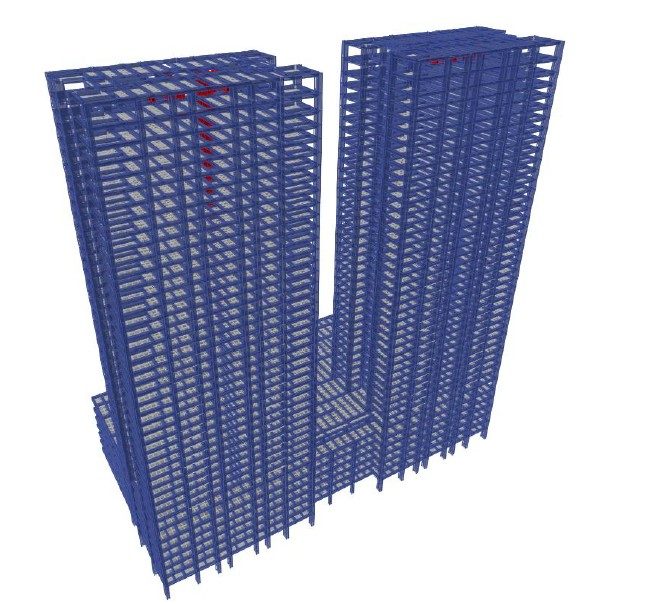
Along the C5 corridor in Pasig City, Project Bloom rises as a four-tower mixed-use development — two residential towers and two office towers. Behind its seismic design sits Dynamis — through structural design, concept development or independent peer review — for Ayala Group, in one of the most seismically exposed capitals on earth.
The building
The development comprises four towers (two residential, two office) along C5 in Pasig City. Dynamis brought performance-based seismic design to the engagement — through structural design, concept development or independent peer review.
Performance-based seismic design
A tall building in a high-seismicity city is not designed to a generic rulebook; it is designed to perform — to deform, dissipate and stay standing through motion that would break a code-minimum structure. That discipline is performance-based seismic design, and it is the engineering Dynamis brings to towers like this one: calibrated to the site, not to a table in a code.
Seismotectonic context
The tower stands in Pasig City, inside one of the most seismically exposed capital regions on earth. The map shows the regional fault context and the historical earthquakes recorded around the site.
Project location: Pasig City, Philippines · 14.586, 121.083
Approximate district location; historical seismicity (M 6+) within ~400 km. Source: USGS.
Why it matters for portfolio risk
- Engineering-gradeFragility for the high-rise asset class grounded in real performance-based design, not off-the-shelf archetypes.
- AccumulationA clear-eyed view of tower exposure concentrated in a single high-hazard metro.
- Defensible PMLLoss indicators a CRO can stand behind, traceable to engineering provenance.
From engineering to risk intelligence
"Fragility curves today are built on simplified assumptions. Ours are built on 15 years of designing structures that cannot fail. By embedding performance-based seismic design into AI-driven models, we transform fragility from generic to engineering-grade. This is not an incremental improvement — it's a structural shift in how seismic risk is quantified."
— Carlos Caramés Molero, Founder & Partner, DynamisFrom that bench come the indicators a (re)insurer actually books: PML for catastrophe risk capital, AAL for technical premium, EP curves for accumulation control, and SCR for Solvency II capital efficiency.
Key questions
Did Dynamis work on Project Bloom?
Yes. Project Bloom (Pasig City) is part of the Philippine high-rise portfolio where Dynamis has applied performance-based seismic design — through structural design, concept development or independent peer review — for the country's leading developers, between 2014 and 2026.
Why does Philippine high-rise experience matter for catastrophe risk?
Metro Manila is one of the world's most seismically exposed capitals. Designing the towers that must perform there produces engineering-grade vulnerability for the high-rise asset class, sharpening PML and accumulation views for insurers with tower exposure.